The symbol representing Jessica Eaton. These symbols come up in your browsing dialogue popup whozits, and you never really know if it’s a lost in machine translation thing or intentional. But I like to think of the triangulating dots as Jessica’s mark. Why not?
I just came across this work, and I am spontaneously popping it in here due to Substantial Initial Connection. See Everything Has Changed Anyway and her Lee Filter work, Spectrum. See Cultivated Mystique and her Quantum Pong. Not making any connection other than flash card, mind you. Haven’t read about process yet. Just sharing the instantaneous recognition of shared marks.
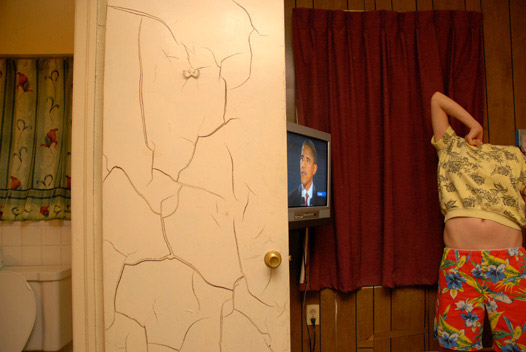
Frank Shebageget is an Anishnabe (Ojibwa) installation artist from Northwestern Ontario, now based in Ottawa. His work is at once familiar and strange – familiar materials and iconography, presented in surprising forms. And once you’re contemplating that mashup, you are likely to go on to contemplate his themes of consumption and colonialism. My corvid taste and monkey mind are normally drawn to flashier, more complicated installation. Note that the photo I chose does not support my description of the work. But feeling the clean simplicity of this work, I wonder if there is hope for me yet. Shebageget has brand new work at the Carleton gallery right now until August 22. If you won’t be able to visit, you’ll have to settle for pictures on a website.
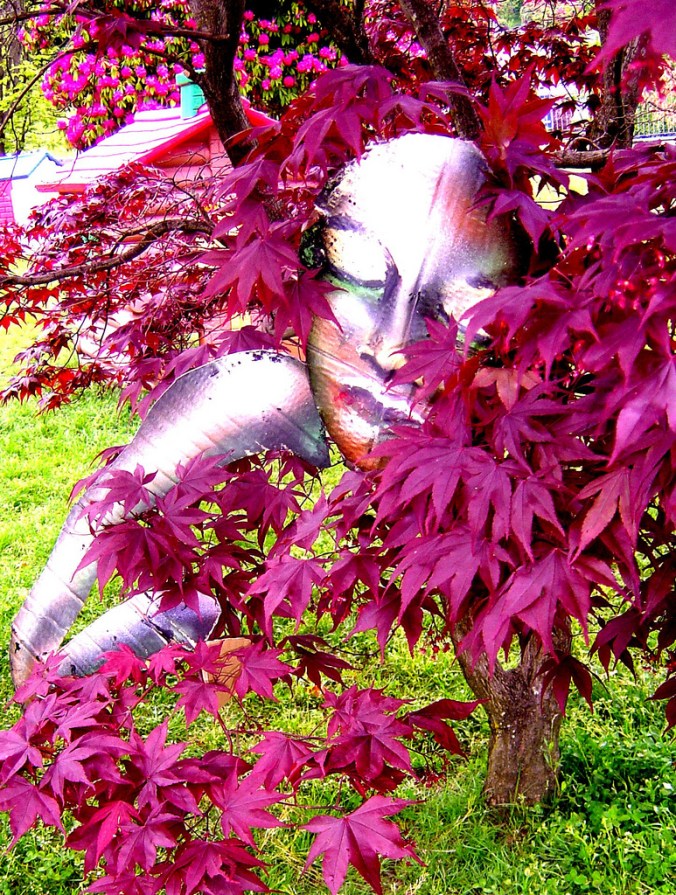
Acknowledging that there is very little new under the internet sun, we do still avoid insta-reblog, particularly from heavy traffic sites like Wooster. Unless forced. And forced we are, by the captivating garden installations of Julio Costa. Feel the delight! Then visit his Flickr, which contains much much more, like painting with light, just plain painting, toy art, straight up graffiti, and social work. While you are visiting there, we will be hatching a plan to visit his gardens…
The card on the wall says “2 channel video, miniature model, mirrors, glass, black light, ghost video, cut-out projection, audio, false walls”. Makes you instantly dig for the price of admission, doesn’t it? Hoffos has said in interviews that he feels artists should give themselves a second childhood. Entering a carnivalesque installation like Scenes From The House Dream feels like joining him there. Learning the grownup thinking behind this atmospheric trip (Jung, bla bla, house as self, bla bla) does not break the spell – it only adds the sensation of the top of the head raising like a drawbridge, giving your moat some air. The work is currently touring out of the National Gallery of Canada.
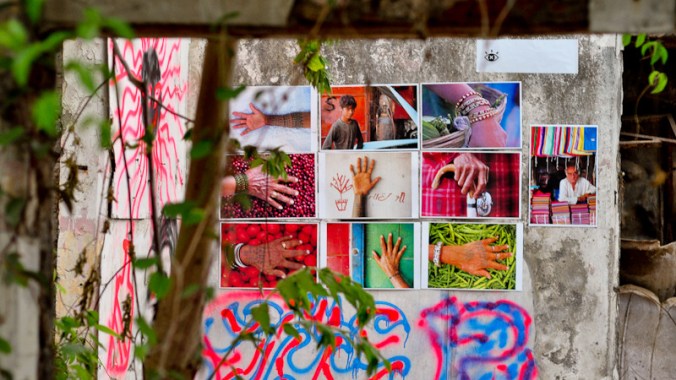
Clicked to Rachel Granofsky‘s site from Wooster’s post of her fun perspective tricks. There I discovered a different series, some of which reminded me of some of Charlie Engman‘s work. What do you think?
We are uptight about our regular online destinations. With limited time and limitless destinations, decisions on whether to view something even once are made hastily and with enormous anti-click bias. Decisions on whether to subscribe or follow or bookmark or otherwise invest repeated time in a site are made with less haste but even more reticence.
The Os Gêmeos blog reassures me that we have not gone too far with the filter. It’s not in English and includes something that prevents Google translate from working. It’s not part of any of our existing “follow factories” like Tumblr or Posterous or Flickr. (There is a link to Flickr but it returns a locked or possibly empty account). It appears not to be designed, not even mediated by the designs of a blogging platform. Yet we visit regularly, using that clunky old school system of memory and bookmark.
The contents range from the expected (documentation of their work), to the classic (“watch this music video we love”), to the whimsical (snapshots of their travels, some with Portugese commentary that would have to be clipped offsite for translation). Scrolling the page, the overall feeling is – surprise – Os Gêmeos: colourful, human, joyful.
And perhaps the absence of bells, whistles, or even helpful features is part of the experience that keeps us coming back. It’s not a gallery with perfect light and soft seating. It’s a wall viewed from inside a speeding train.
When I think of some of the things I was made to read at school, instead of Miss Lonelyhearts, I have more patience for the endless debate about The Canon.
I kicked off my camping season this weekend, and inexplicably, I brought with me the little paperback Miss Lonelyhearts and A Cool Million, which I have packed and unpacked in numerous changes of residence, yet somehow never read. I do respect the Buddhist precept about consuming only items that preserve peace in body and consciousness, and while my practice of it would not by any means be considered thorough, I do generally avoid depictions of extensive or graphic violence. Maybe that was the hold up.
In any case, I now know that in future, should I wish to consume some harshness, I should do so in solitude, in nature. Sitting and hiking and sleeping and sitting in the woods or at the shore tops up my peace…it may even create a surplus.
Of course, West’s story is a bit of a paradox for sensitive souls such as mine, as it is the story of just such a sensitive soul and the madness brought about through his consumption of depictions of rape, gang rape, gay bashing, and wife beatings which result in dental work. Tricky.
But it is a short work, a one-sitting read, and the sufferings are surrounded by astounding passages of philosophy, surrealism and humour. Its masterful and strange presentation of big ideas is moving, and while ultimately disturbing, it can still be peacefully consumed provided the reading environment is sufficiently serene and beautiful.
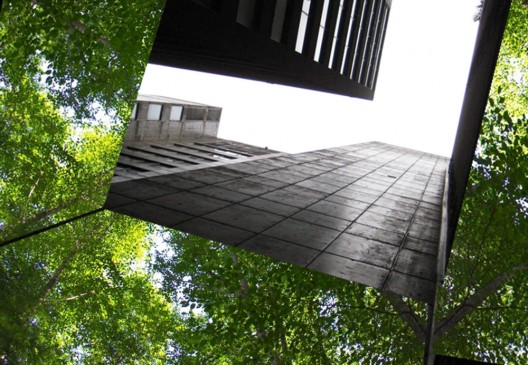
“The Infinity Forest is a green oasis amongst the hard, vertical walls of Penfold’s and Hosking Place.” Sydney. As there is no mention of any sound component to this intervention, I imagine the sound inside the box is much the same as outside, and I wonder if this adds or detracts from the Infinity Forest experience.
Given the impact each viewing of Tarkovsky’s work has had on me, I cannot explain why it’s taken me ten years to watch four films. Maybe part of that can be attributed to watching The Sacrifice repeatedly. Maybe not.
Anyway, I need to take a little webspace to genuflect right now. Not to prowess, or achievement, or mastery, although I assume all of those must be present to create this kind of Stendhal-inducing work. Masterful filmmakers are not in short supply. However, from everything I have read, few if any have been able to create the particular experience Tarkovsky creates. I am admittedly prone to hyperbole, but on this topic, I risk writing stale if I employ concepts like spellbound, otherworldly, euphoric, and transcendental.
Of course, there are as many who have an experience of boredom, confusion, or impatience. Which is why my genuflecting webspace will be devoted to proselytizing thusly: many things which are good for you do not feel so good going in. If you are determined to reap the goodness, you must learn to find your way beyond the not good feeling. Tips:
“slow” can be good. Think food, think sex, think Tarkovsky. It’s a feast.
engage. Tarkovsky preferred mise en scene to montage, feeling that cuts are tricks. Instead of a steady conveyor belt of bite-sized meaning, you get an open field in which to wander, and joining you in the field at unpredictable intervals and angles will be various-sized meanings.
you think you are reading it, but you will read it differently as you go. What at first seems spooky will become romantic.
And what is the goodness to be reaped? Contemplative travel to some very rich and mystical ideas about life and death. Time distortion. Dreams, memory, magic.
But maybe you’re not up for that tonight. That’s cool too, you can totally just dig on the crocheted ponchos and the sound of the Russian language and the inexplicably floating chandeliers.






 Even More Legendary
You must be logged in to post a comment.